
Corporate E-Waste Disposal in Bengaluru: Documents, Certificates & Compliance Checklist
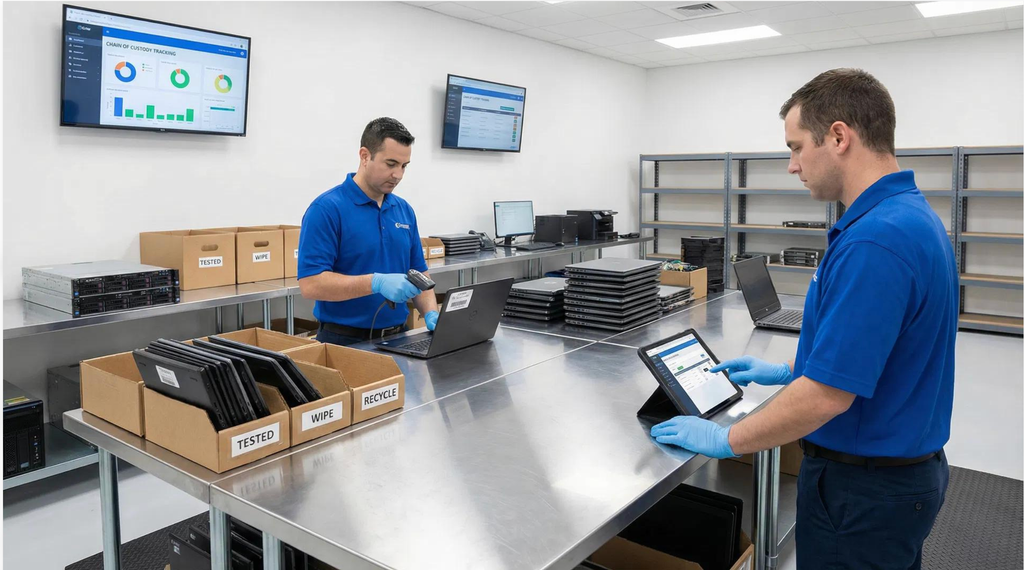
When a business replaces its laptops, upgrades its servers or clears out old IT equipment, disposal involves more than removing unwanted devices. Companies also need to consider data security, asset records, responsible recycling and the documentation required for their own internal processes.
For IT, procurement, administration, facilities and compliance teams, a well-planned e-waste disposal process can make asset retirement easier to track and manage.
This guide explains the documents businesses should discuss with an e-waste recycling partner, how to evaluate a service provider, and what to prepare before scheduling a corporate collection in Bengaluru.
Why Does Documentation Matter in Corporate E-Waste Disposal?
A business may retire dozens or hundreds of laptops, desktops, monitors, storage devices, networking equipment and other electronic assets at a time.
Without a clear record of what was collected and how it was handled, it can become difficult to close internal asset records, demonstrate completion of a disposal project or verify that sensitive storage devices were dealt with as agreed.
A well-organised process helps your business:
- Maintain a record of retired IT assets.
- Track collection quantities and asset identifiers where applicable.
- Document agreed data destruction activities.
- Obtain relevant disposal and recycling records.
- Support internal procurement, finance, security and audit processes.
- Confirm the service provider’s applicable authorisations and capabilities.
The key principle: Agree on the scope, documents and responsibilities before the equipment is collected.
Which Documents Should Your Business Ask For?
The exact documents depend on the equipment, the service provided, applicable rules and the terms of your project. Not every document listed below is mandatory for every company or every disposal.
1. Recycler Authorisation and Registration Details
Before appointing a vendor, check the provider’s relevant authorisations, registrations and permitted scope of operations.
For e-waste activities covered by the E-Waste (Management) Rules, 2022, consult the official CPCB portal and applicable regulatory information to verify the relevant registration and status.
Ask the provider to share current documents and confirm that the activities offered are covered by its applicable permissions.
2. Asset Inventory and Collection Record
Prepare a list of the equipment being retired. Depending on your internal process, this may include:
- Equipment type and quantity.
- Asset tag or serial number, where applicable.
- Storage-device details where data destruction is required.
- Collection location and scheduled date.
- Handover or collection acknowledgement.
- Any exclusions or items that require separate handling.
This record helps both parties establish what was included in the project.
3. E-Waste Disposal or Recycling Documentation
Ask what record will confirm the handover and subsequent handling of the collected equipment.
Depending on the agreed service, this may include a disposal or recycling certificate, a collection acknowledgement, a material summary or other project documentation.
Confirm what each document actually certifies. A collection acknowledgement alone does not necessarily prove that every asset has completed the recycling process.
4. Certificate of Data Destruction
If your project includes HDD, SSD, server or laptop data destruction, agree on the required evidence in advance.
Depending on the service, records may include:
- Asset or storage-device identifiers.
- The destruction or sanitisation method used.
- Completion date.
- The outcome of the process, where applicable.
- A Certificate of Data Destruction or an asset-level report.
The certificate should accurately reflect the work performed. Do not assume a device was securely wiped simply because it was collected or formatted.
For more detail, read our related guide: Secure Data Destruction in Bengaluru.
5. Manifest or Transport Documentation, Where Applicable
Depending on the type of material, applicable requirements and project arrangements, transport or movement records may be needed.
Ask the service provider which records apply to your particular consignment and confirm who is responsible for preparing and retaining them.
Do not assume that one specific form is mandatory for every corporate e-waste collection.
6. EPR-Related Documentation, Where Applicable
Extended Producer Responsibility (EPR) under India’s E-Waste (Management) Rules, 2022 primarily establishes obligations for the regulated stakeholders, including producers, and a framework involving registered recyclers.
A corporate customer disposing of its own retired office equipment should not automatically assume that it needs an EPR certificate for every collection. The requirements depend on the entity’s role and the applicable regulatory framework.
If your project involves producer EPR obligations or related recycling documentation, confirm the applicable requirements with your compliance team and the relevant registered stakeholder.
7. Environmental or Carbon-Related Certificates
Some service providers may offer environmental impact summaries or carbon-related documentation as an additional service.
Ask how the figures are calculated, what activity they represent and whether the document is independently verified, if that is important to your organisation.
Treat these as additional evidence or reporting tools—not as a substitute for applicable authorisations or required disposal records.
Your Corporate E-Waste Disposal Checklist
Use this checklist before finalising a corporate disposal project.
Before collection
- Prepare an inventory of the equipment being retired.
- Identify HDDs, SSDs and other storage media requiring data sanitisation or destruction.
- Confirm the provider’s relevant authorisations and permitted scope.
- Agree on the collection location, date and handover process.
- Confirm pricing, valuation and any applicable taxes.
- Agree on the documents and reports to be supplied.
- Confirm responsibilities for packing, transport and asset custody.
During the project
- Reconcile the items handed over against the agreed inventory.
- Record discrepancies or excluded assets.
- Follow the agreed process for data sanitisation or physical destruction.
- Retain relevant handover and movement records.
- Escalate damaged, missing or unidentified storage devices.
After collection and processing
- Obtain the agreed disposal or recycling documentation.
- Obtain data destruction records if that service was included.
- Reconcile asset identifiers and quantities.
- Retain records according to your company’s policies and applicable requirements.
- Close the internal asset retirement or procurement process.
How to Choose an E-Waste Recycler in Bengaluru
Price is important, but the lowest quotation alone may not tell you whether a vendor can meet your operational and documentation requirements.
Before you decide, consider these five factors.
1. Relevant authorisations
Check the provider’s current documents and verify that the relevant activities are covered.
2. Data security capability
If you are disposing of company storage devices, ask how the provider handles data sanitisation, physical destruction, failed drives and asset-level reporting.
3. Clear documentation
Agree on exactly which certificates, reports and acknowledgements will be supplied, and what each document proves.
4. Transparent commercial terms
Confirm the valuation method, collection charges if any, taxes, timelines and responsibilities before approving the project.
5. Traceable processing arrangements
Ask where the equipment will be processed, which activities are performed by the provider, and whether any downstream processing is handled by another party.
A dependable partner should be able to explain its process clearly and provide evidence that matches the work performed.
Corporate E-Waste Disposal Services for Bengaluru Businesses
Recyclicaa Private Limited supports corporate requirements involving IT asset disposal, e-waste recycling and secure data destruction, subject to the agreed project scope and service arrangements.
Businesses planning an office clearance, laptop refresh, server retirement or bulk IT equipment disposal can discuss:
- Corporate laptop and desktop disposal.
- HDD and SSD data sanitisation or physical destruction.
- Asset inventory and destruction reporting.
- E-waste collection and recycling arrangements.
- Project-specific documentation and compliance requirements.
Collection availability, processing location, applicable authorisations and deliverables should be confirmed with our team before a project is scheduled.
Frequently Asked Questions
What documents should I receive after corporate e-waste disposal?
The documents depend on your project. They may include a collection acknowledgement, asset or quantity summary, disposal or recycling documentation and data destruction records if destruction was included. Agree on the deliverables before collection.
Is a Certificate of Data Destruction the same as an e-waste recycling certificate?
No. They serve different purposes. A data destruction certificate documents a data-related process, while disposal or recycling documentation relates to the handling of the equipment or materials. Check what each certificate covers.
Does every business need an EPR certificate when disposing of old laptops?
Not automatically. EPR obligations depend on the entity’s role and the applicable rules. Businesses should assess their specific circumstances rather than assuming that every equipment disposal requires the same EPR documentation.
Should I check a recycler’s authorisation before collection?
Yes. Verify the provider’s relevant current authorisations or registrations and confirm that its permitted scope covers the services being offered.
Can a business arrange bulk e-waste collection in Bengaluru?
Collection arrangements depend on the location, equipment quantity, project scope and service availability. Share these details with the provider to discuss the collection plan and quotation.
Can old equipment be reused instead of recycled?
Where equipment is functional, suitable and meets the relevant data security and quality requirements, reuse or refurbishment may be an option. Equipment that is unsuitable for reuse should be routed through an appropriate recycling or disposal process.
Planning a Corporate E-Waste Disposal Project?
Before your next laptop refresh, office clearance or server decommissioning project, make sure you have a clear inventory, an agreed data security process and documentation that matches the service delivered.
Contact Recyclicaa Private Limited to discuss your corporate IT asset disposal, secure data destruction and e-waste recycling requirements in Bengaluru.
Website: https://www.eeerecycler.com/
Contact: +91 9576771555 / info@eeerecycler.com
Related reading: IT Asset Disposal in Bengaluru and Secure Data Destruction in Bengaluru.
RECYCLICAA PRIVATE LIMITED
Planning a Corporate E-Waste Disposal Project?
Discuss your old laptops, IT assets, data destruction requirements and disposal documentation with our team.
Visit Our WebsiteCorporate IT Asset Disposal
Secure Data Destruction · E-Waste Recycling